Agentic AI: The Power of Intelligent Automation in IT Asset Operations
Learn how Agentic AI improves IT asset operations by moving from alerts and reports to intelligent, goal-driven execution.
If Generative AI explains and recommends, Agentic AI acts.
Imagine a world where your IT assets don’t just sit in a database waiting for someone to notice a problem. Instead, the system itself anticipates needs, makes reasoned choices within clear boundaries, and executes actions. That’s the promise of Agentic AI, and it’s already moving from concept to reality in leading organizations.
What Is Agentic AI?
Agentic AI is an artificial intelligence system that achieves a specific goal with limited human supervision. It comprises AI agents—machine learning models that mimic human decision-making—solving problems in real time by evaluating context, selecting actions, and executing tasks.
For example, in software testing, traditional tools simply record which tests failed. An agentic approach helps teams manage failed test cases by spotting which failures keep coming back, judging which ones carry the most risk, and deciding what should be investigated or retested first, while humans still confirm the final call.
In IT Asset Management, Agentic AI can perform asset-related tasks across workflows based on predefined rules, permissions, and approvals, etc., rather than just generating text or suggestions.
Unlike traditional AI models, which operate within predefined constraints and require human intervention at each step, Agentic AI exhibits the following:
- Autonomy (acts independently within guardrails)
- Goal-driven behavior (optimizes toward outcomes, not outputs)
- Adaptability (responds to changing environments)
The term “agentic” refers to this agency - the capacity to act independently and purposefully.
The Applications of Agentic AI in IT Asset Operations
Agentic AI introduces a shift in IT asset management: from tools that record and report to systems that can decide and act within defined rules. While traditional ITAM automation handles predefined tasks (such as scheduled scans or alerts), Agentic AI goes a step further by evaluating context, choosing the next action, and executing workflows across systems.
Below are practical areas where Agentic AI can make a real impact in ITAM.
Intelligent and autonomous asset management
As device volumes grow, maintaining accurate asset records becomes increasingly complex. Modern ITAM tools already automate data imports from sources such as network scans and endpoint management systems (like Intune), and they trigger reminders for warranties or scheduled maintenance.
Automated Asset Tracking System: 7 Key Features to Look for
Agentic AI brings this much further.
Instead of simply storing records or raising alerts, AI agents continuously evaluate usage patterns, performance signals, patch status, and lifecycle compliance under reliable data inputs in place. When anomalies are detected, the agent analyzes them in context, comparing them against security policies, lifecycle rules, cost thresholds, and user risk profiles.
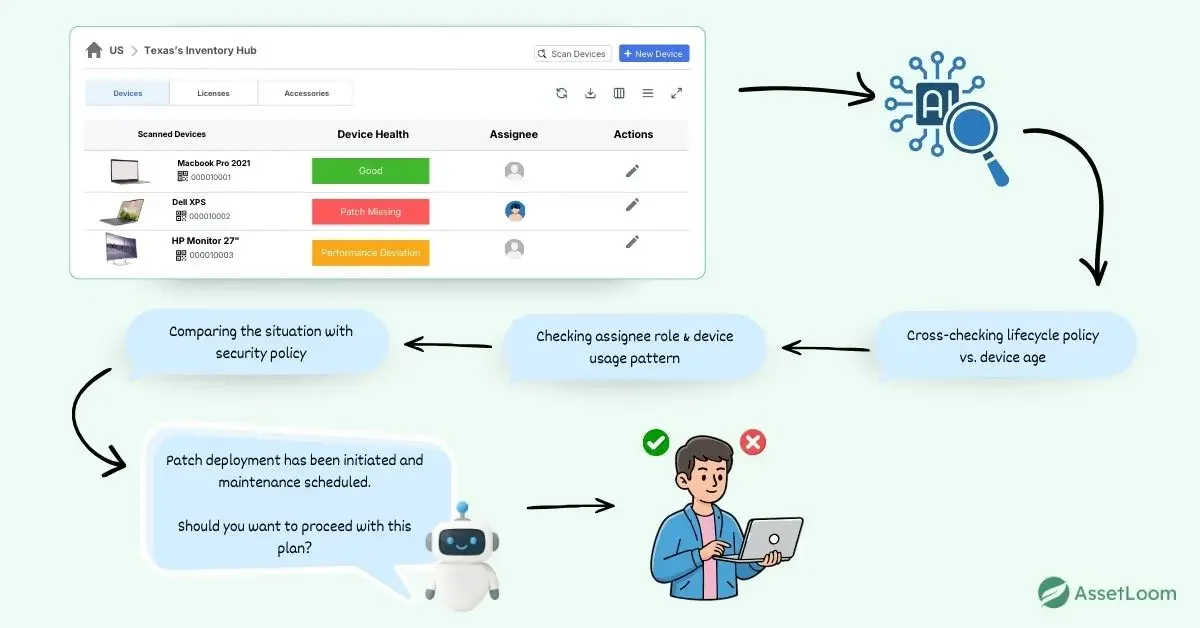
From there, the agent determines the appropriate response path. For low-risk scenarios within predefined policy limits, such as routine patch deployment or maintenance scheduling, the agent can initiate automation directly. For higher-risk, cost-sensitive, or policy-impacting actions, it generates a recommended plan and routes it to administrators for review and approval before execution.
Beyond risk prevention, agents also optimize resource allocation, ensuring assets are available when needed while avoiding unnecessary stockpiling. The shift is clear: from passive IT asset tracking to active asset lifecycle optimization with intelligent automation.
Intelligent software license allocation
Software remains one of the most expensive asset categories in most organizations, with underutilization leading to significant financial waste. Traditional ITAM tools already help by tracking license usage and monitoring SaaS consumption. But Agentic AI can transform this into a closed-loop license management system, where it can:
- Allocate licenses automatically when users join or change roles
- Reclaim licenses when they are no longer used
- Analyze licensing terms and compare them with real deployment data
- Identify compliance risks before they escalate
So, instead of reacting to audits, organizations move toward continuous compliance with Agentic AI.
Intelligent change and configuration management
Change management is often time-consuming and risk-sensitive. AI agents enhance this process by proactively evaluating the potential impact of proposed changes across the IT environment.
By analyzing relationships between configuration items (CIs) in the CMDB, agents can identify hidden dependencies and recommend the optimal timing for implementation based on infrastructure usage patterns. Low-risk, routine changes can be executed automatically within governance boundaries, while high-impact changes remain under human control.
Early Production Signals of Agentic AI in ITAM
AI agents are increasingly being applied in ITAM workflows that require multi-step reasoning, context evaluation, and governed decision-making. They:
- Understand goals, such as fulfilling requests or maintaining compliance
- Evaluate real-time data and policy constraints
- Select the optimal response path
- Coordinate workflows across systems
- Escalate high-risk actions for human approval
Rather than simply triggering predefined tasks, these systems reason through workflows and dynamically select actions, reducing manual workload, improving asset utilization, and enhancing operational efficiency.
While full autonomy across all ITAM domains is not yet common, these examples indicate the direction of agentic IT operations today.
What’s Next for AssetLoom
Agentic AI is not a distant concept. It’s the natural evolution of intelligent IT operations. As an advanced IT asset operations platform, AssetLoom approaches Agentic AI not as a standalone feature, but as an operational layer that works across workflows, policies, and lifecycle management. This is part of our roadmap vision.
We’re exploring how autonomous ITAM agents could one day interpret policies and assist with onboarding and offboarding workflows. We’re also investing in natural language interfaces that make asset insights accessible beyond IT teams. And we see strong potential in AI-driven prioritization, which helps organizations focus on the tasks that carry the highest financial and compliance impact.
This isn’t about replacing human decision-making. It’s about strengthening it with intelligent systems that can adapt, reason, and support execution at scale. The AI evolution in IT Asset Management is already underway, and AssetLoom is building toward that future.