Configuring Jamf Pro Sync Behavior
Learn how to configure Jamf Pro sync behavior in AssetLoom, manage device updates, and control how synced data is handled.
Once Jamf Pro is connected to AssetLoom, you can access the Jamf Pro integration details page from the Integrations hub. See Connecting Jamf Pro with AssetLoom for how to get there.
This guide walks through the Sync Behavior tab on that page, which determines how AssetLoom handles conflicts between Jamf data and existing AssetLoom data, and how synced user data affects asset assignments.
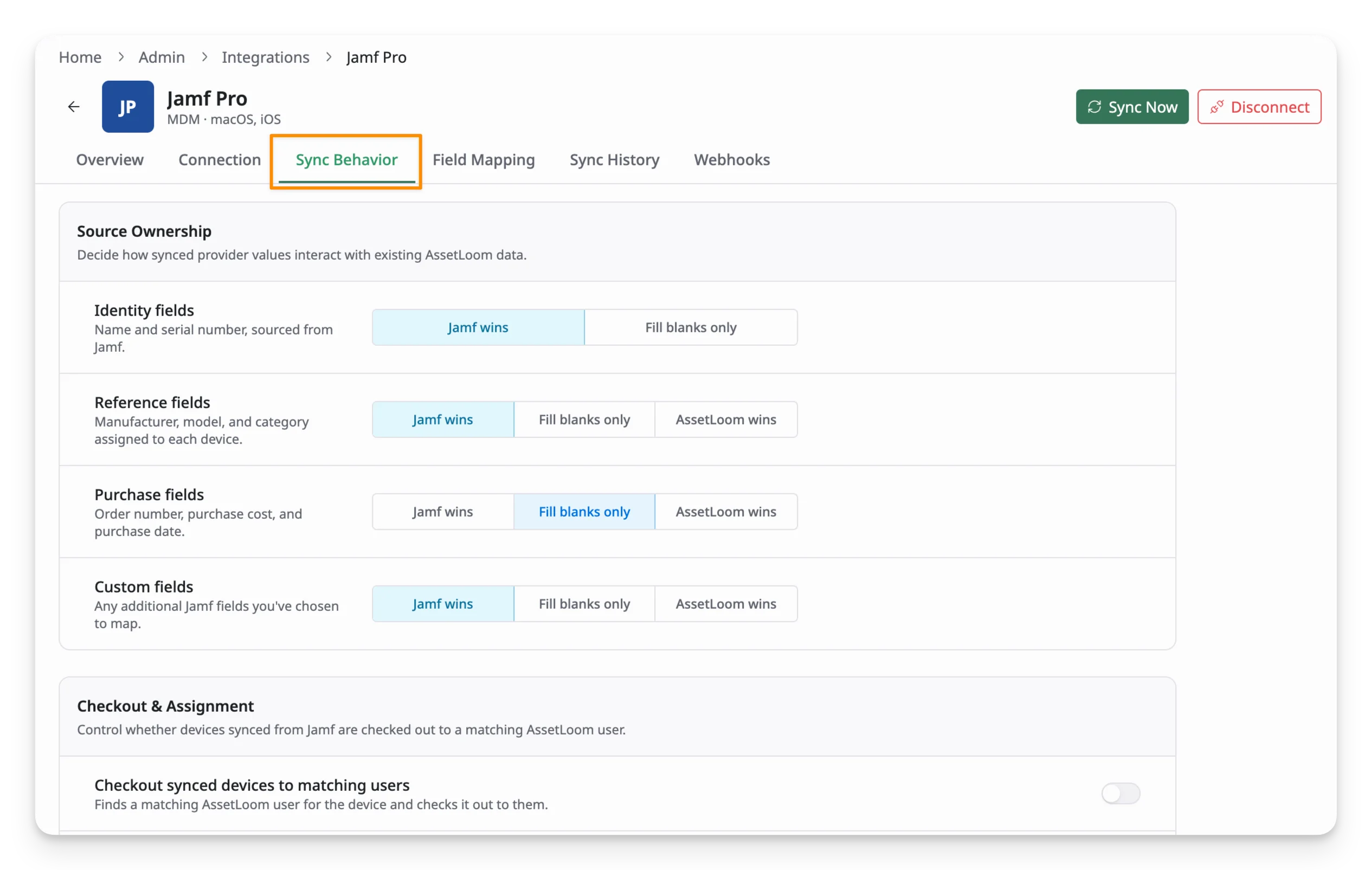
Set Up Sync Behavior
The Sync Behavior tab controls how AssetLoom resolves conflicts between data synced from Jamf and data already in AssetLoom (1), and how synced user data affects asset assignments (2).
1. Source Ownership
This section decides how synced values from Jamf interact with existing AssetLoom data, broken down by field group.
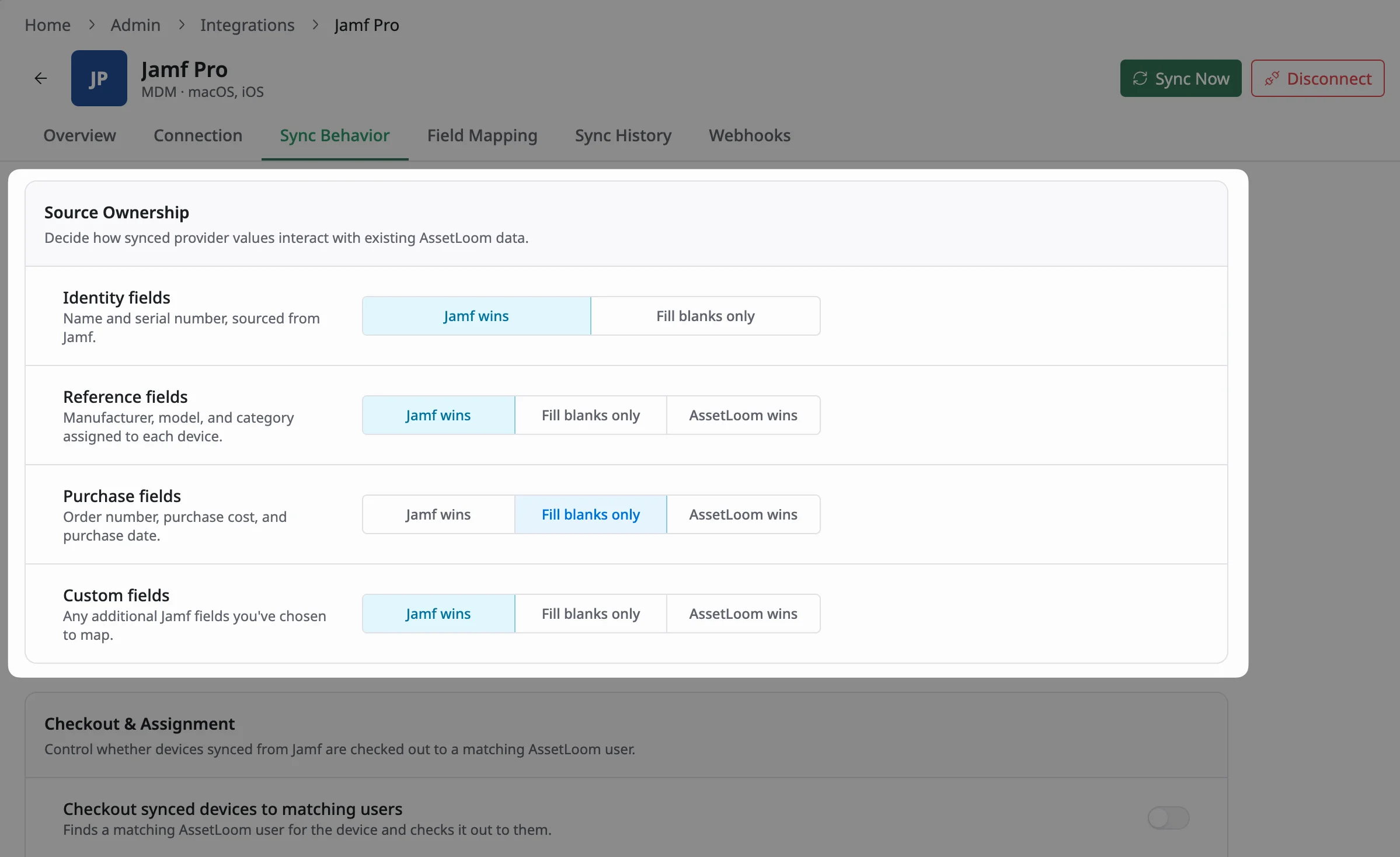
The available options for each group are as follows:
| Option | What It Does |
| Jamf wins | Jamf's value always overwrites the AssetLoom value, even if AssetLoom already has data in that field. |
| Fill blanks only | Jamf's value is only applied if the AssetLoom field is empty. Existing AssetLoom data is never overwritten. |
| AssetLoom wins | AssetLoom's value is always kept, even if Jamf has a different value. Jamf data is not synced into this field. |
The field groups are:
- Identity fields: Name and serial number, sourced from Jamf. (Only “Jamf wins” and “Fill blanks only” are available for this group, since identity fields are expected to originate from Jamf Pro.)
- Reference fields: Manufacturer, model, and category assigned to each device.
- Purchase fields: Order number, purchase cost, and purchase date.
- Custom fields: Any additional Jamf fields you’ve chosen to map.
For each field group, choose Jamf wins, Fill blanks only, or AssetLoom wins, depending on how you want conflicts resolved.
Source Ownership controls whose value is kept when a conflict occurs. It doesn’t control which Jamf field maps to which AssetLoom field. If you’re wondering how a specific value from Jamf gets applied to a field in AssetLoom, see the Field Mapping guide to configure that.
2. Checkout & Assignment
This section controls whether AssetLoom tries to match a synced device’s Jamf user to an existing AssetLoom user, and if a match is found, checks the device out to that person.
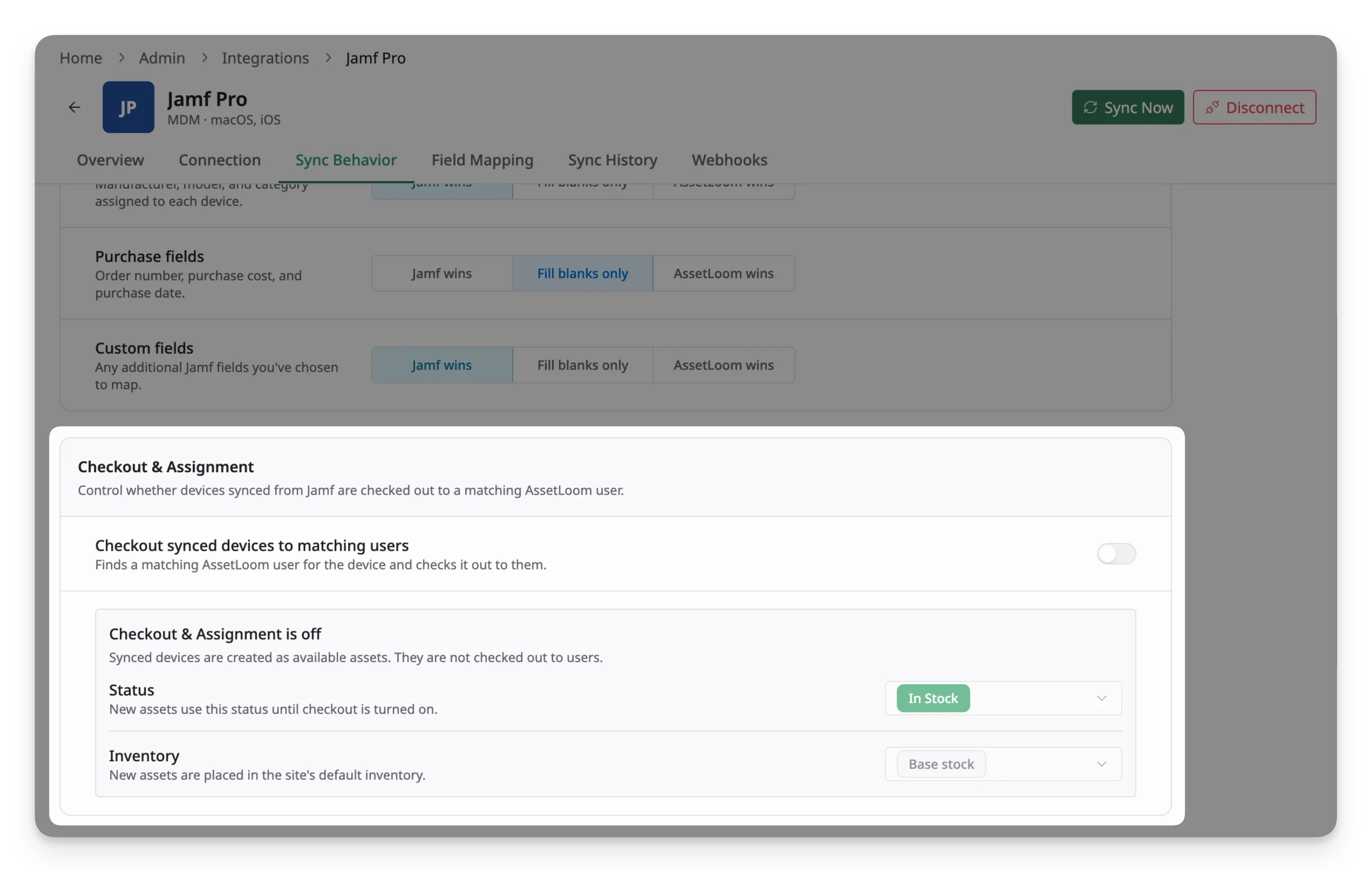
When Checkout & Assignment is off
When Checkout synced devices to matching users is disabled, synced devices are created as available assets with In stock status and belong to Base Stock inventory by default. No action is needed.
When Checkout & Assignment is on
Enable Checkout synced devices to matching users if you want AssetLoom to use the user information received from Jamf Pro to assign synced devices automatically.
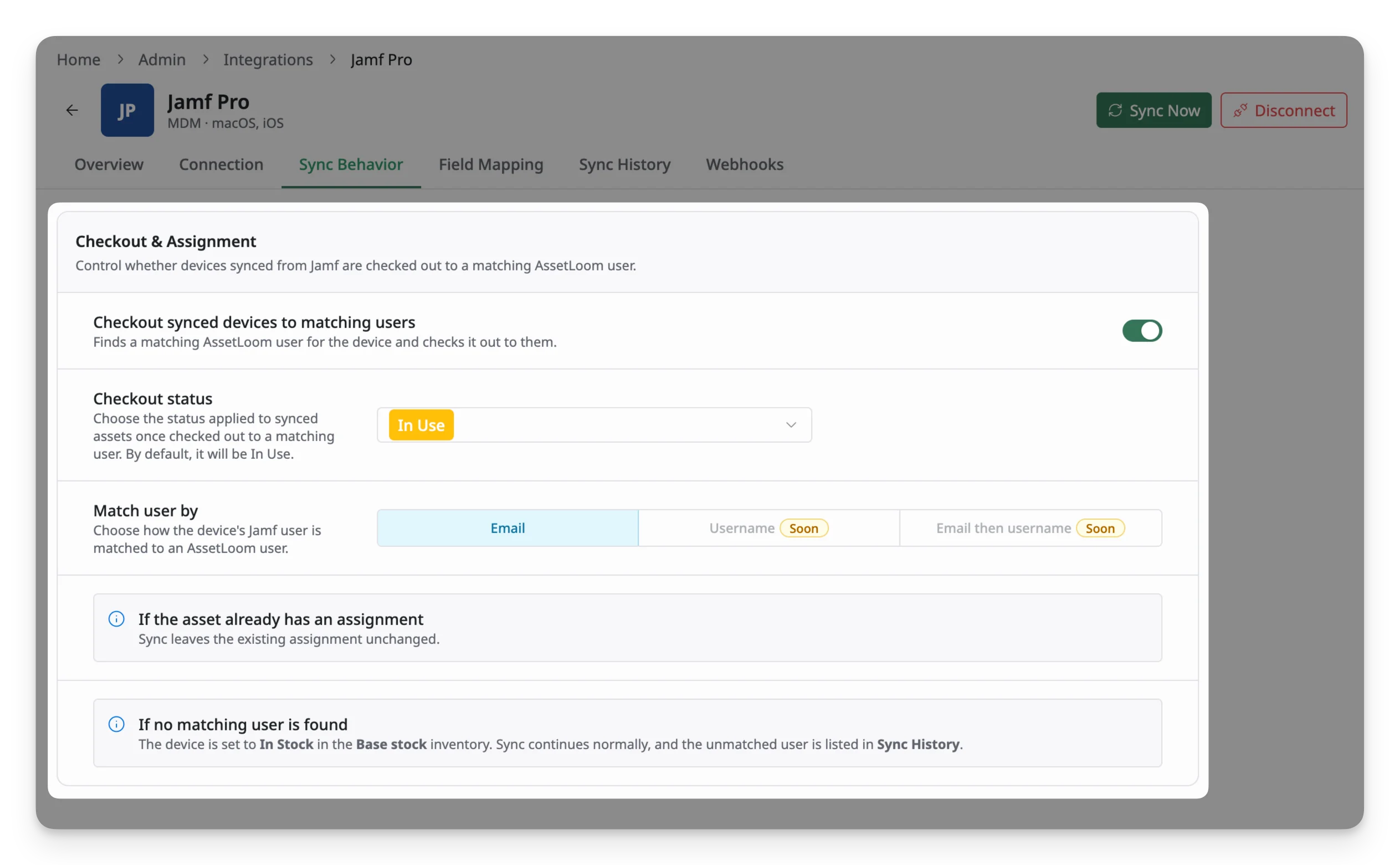
| Setting | What It Does |
| Checkout status | Select the status applied when a synced asset is successfully checked out to a matching user. The default is In Use. |
| Match user by | Determines how the Jamf Pro user is matched with an existing AssetLoom user. Currently, matching by Email is available. Username and Email then username are planned for a future update. |
If a synced asset is already assigned to someone in AssetLoom, the sync leaves the existing assignment unchanged.
This prevents a Jamf Pro sync from replacing an assignment that is already being managed in AssetLoom.
If AssetLoom cannot find a matching user, the synchronization still proceeds with:
- The device is synced normally and set to In Stock as an available asset.
- The device is placed in the Base Stock inventory.
- The unmatched user is recorded in Sync History for review.
What happens next
Your Sync Behavior settings are applied to future sync runs and determine how incoming Jamf Pro data is handled as device records are created or updated.
After configuring Sync Behavior, continue to Field Mapping to define how individual Microsoft Jamf Pro fields correspond to fields in AssetLoom.