What Is AI Asset Management? The Missing Layer Between AI Inventory & Governance
AI asset management brings every AI tool into one inventory your team can govern. See what managing your AI assets actually takes.
Most companies do not struggle with AI governance because they lack policies. They struggle because they do not have a clear view of what AI exists. McKinsey found that 88% of organizations use AI in at least one business function. But Flexera reports that only 31% have visibility into the AI software in their environment.
This is where AI asset management becomes important. You cannot govern AI well if you do not know what AI assets exist, who uses them, or how they are connected to the business.
What Is AI Asset Management?
AI asset management is the practice of discovering, tracking, and governing every AI model, agent, API, and embedded tool an organization uses. Unlike AI-powered asset management, which uses AI to monitor physical equipment, AI asset management focuses on managing the AI itself.
It serves as a central system of record bridging AI adoption and governance, giving organizations full visibility into:
- Inventory & Ownership: What AI exists and who owns it.
- Shadow AI & Access Points: How AI enters the enterprise (from personal SaaS accounts to internal models and MCP servers).
- Capabilities & Reach: What external data, systems, and actions an AI agent is permitted to touch.
What Actually Counts as an AI Asset
True AI asset management requires looking beyond basic software inventories; it must account for the entire interconnected AI system across three core layers:
- Technology Layer: The foundation (providers, applications, models, agents, APIs, and MCP clients/servers).
- Data & Behavior Layer: The controls (datasets, system prompts, fine-tuning data, and safety guardrails).
- Business Layer: The output (workflows, integrations, and the end business use cases).
These layers connect in a simple chain: a provider offers an application, model, or agent; that technology touches data and prompts; it runs inside a workflow; and the workflow serves a business use case.
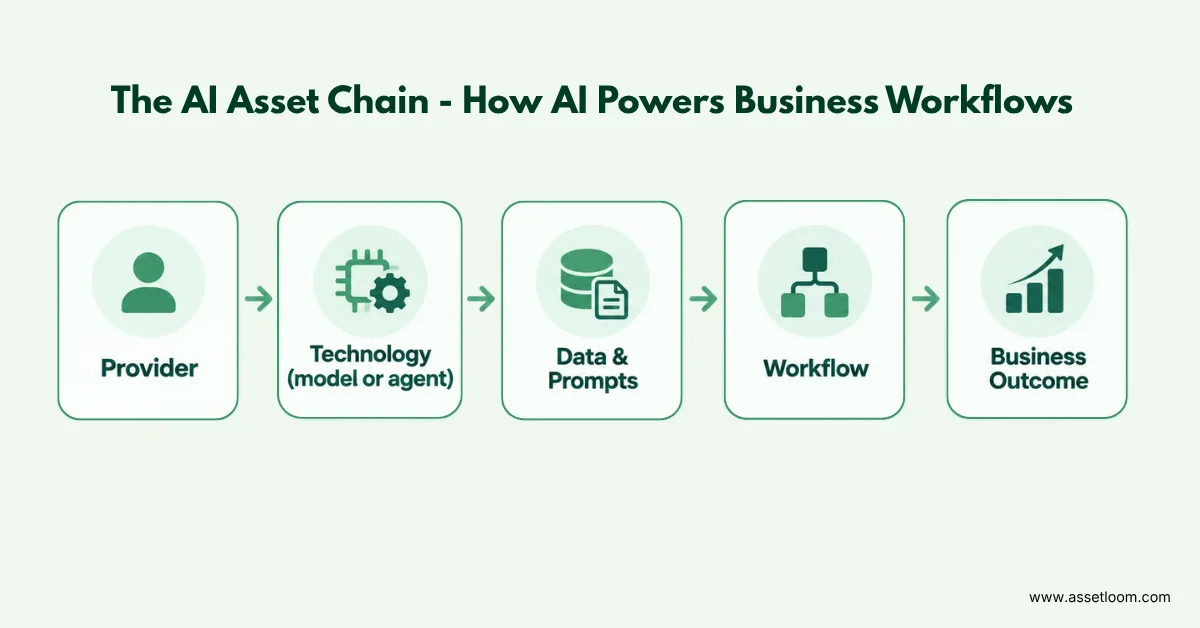
The key is to manage these relationships, not just individual assets. A simple spreadsheet may show what AI exists, but it can easily miss what each asset connects to, what data it uses, and what actions it can take.
Why You Also Have to Track AI Use Cases, Not Just Technology
An AI asset record tells you what AI technology exists. An AI use-case record explains why it is used, who uses it, and what data is involved. This distinction matters because the same AI tool can have very different risks depending on how it is used.
Take a single ChatGPT Enterprise license, used by two teams in the same company:
- Marketing uses it to brainstorm public campaign ideas. No sensitive internal data is involved, so the use case may be Approved.
- HR uses the same license to summarize candidate evaluations and salary information. Because it involves personal and sensitive data, the use case may be Conditional and require extra controls.
Same technology asset. Same vendor. Same license. Two entirely different risk profiles. If your inventory only records “ChatGPT Enterprise: Approved,” it is silently wrong for HR, and we’d argue that’s not an edge case; it’s the norm. Most enterprise AI tools get adopted by more than one team, for more than one reason.
Effective AI asset management connects two types of information:
- Asset information: What the AI is, which version is used, where it runs, and who owns it technically.
- Use-case information: Why it is used, what data it handles, what decisions it affects, and who owns the business outcome.
Together, these give security, compliance, procurement, and business teams better context for access and risk decisions. For every AI resource, you should be able to answer five questions:
- What is it? Identify the application, model, agent, API, or service.
- Who owns and uses it? Record the technical owner, business owner, and users.
- Why is it being used? Define the business purpose.
- What can it access? Record relevant data, systems, and permissions.
- What is the governance decision? Mark it as Approved, Conditional, Under Review, or Rejected.
If your inventory cannot answer these five questions, you don’t have AI asset management; you just have an AI list.
How This Differs From ITAM, MLOps and AI Governance
AI asset management doesn’t compete with the tools you already run. It fills in what they can’t see, connecting their separate views of AI into one picture.
This table shows exactly where each discipline stops seeing the full AI picture, and why none of them alone gives you the whole story.
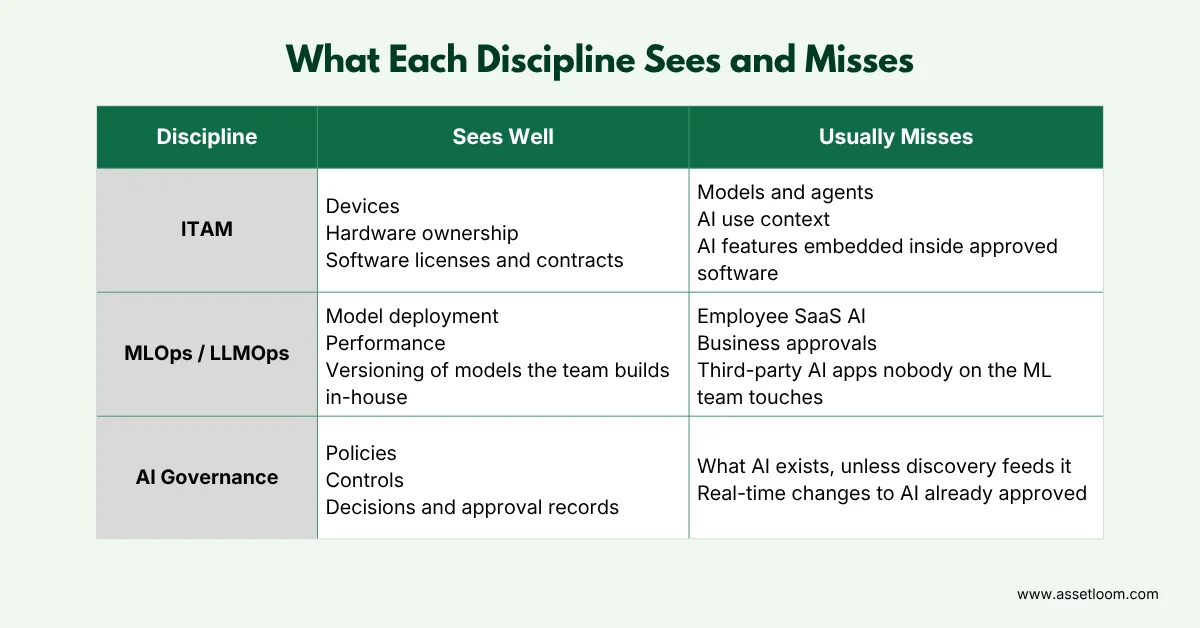
Traditional ITAM gives you visibility into devices, software, licenses, and ownership, but it usually does not capture models, agents, or AI use context. MLOps knows how a model performs, but not whether an employee is using an unapproved chatbot next door. AI governance can write every rule a company needs, but a rule only works once someone tells it what AI actually exists to apply it to.
This is the gap AI asset management closes. It provides the inventory and evidence that IT, MLOps, and governance teams need to manage AI with a shared view of what actually exists.
How to Build an AI Asset Management Program
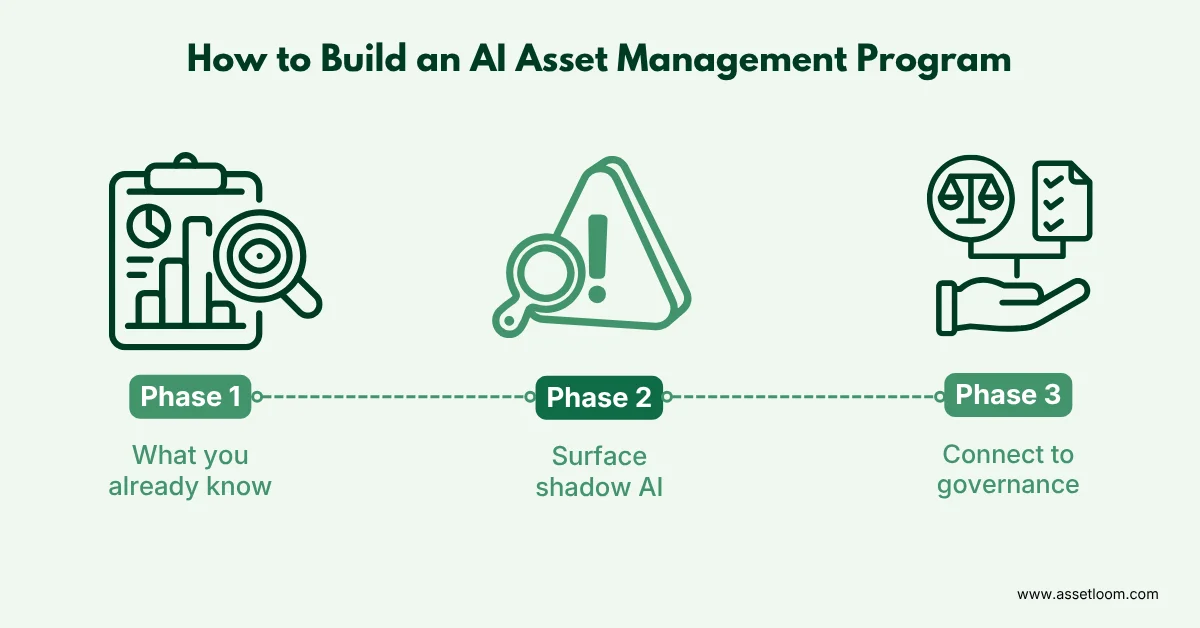
You do not need to find every AI system on day one. A practical AI asset management program starts in three phases and matures as your visibility grows.
Phase 1: Baseline What You Already Know
Start by consolidating existing organizational records:
- Procurement & Legal: Software contracts, SaaS purchases, vendor security reviews
- Technical Registries: Cloud AI services, internal model registries, active development projects
- Policy & HR: Approved application lists, employee declarations
This baseline only shows AI that went through formal channels. It is a starting point, not a complete inventory.
Phase 2: Discover What the Baseline Missed
Uncover unsanctioned or Shadow AI by analyzing operational signals:
- Telemetry Sources: Use identity systems (SSO), network activity, endpoints, browser extensions, expense reports, and cloud platform APIs to find AI tools your existing inventory may have missed.
- Deduplication: Combine overlapping signals. If five data sources detect the same AI product, they should support one asset record, not create five separate records.
- Privacy by Design: Focus on metadata such as application, account, spend, and department. Avoid collecting prompts, keystrokes, or productivity metrics unless deeper security analysis requires it.
AI can also enter outside formal procurement. Shadow IT Discovery can help surface applications and access activity that may need further review.
Phase 3: Connect Discovery to Governance
Finding an asset is only the first step. Effective AI governance depends on connecting each asset to its business purpose, owners, data access, and approval status. Keep these records updated as permissions change or contracts expire.
Ultimately, measure program success by coverage and ownership quality, not total asset count. The objective is simple: close the gap between the AI operating in your environment and the AI your governance team actually understands. From there, ongoing governance transitions seamlessly into formal AI Asset Lifecycle Management.
Conclusion: Why AI Asset Management Is Becoming a Control Layer
AI inventory is becoming more than a static list. As AI agents connect to data, APIs, and internal tools, teams need to track not only what exists, but also what each AI asset can access and whether that access changes over time.
NIST’s AI Risk Management Framework already reflects this need through AI inventory requirements in GOVERN 1.6 and safe decommissioning in GOVERN 1.7. Effective control follows a simple flow: Know what exists → Understand how it is used → Govern the decision → Keep the record current.
At AssetLoom, we see AI asset management as a natural extension of AssetOps. Discovery has to come before governance. Our direction is to connect AI discovery, inventory, ownership, and governance context so teams can keep control as their AI environment continues to change.
FAQs
1. Is AI asset management the same as AI-powered asset management?
No. AI asset management manages AI as an organizational asset, including applications, models, agents, APIs, use cases, ownership, and related records. AI-powered asset management uses AI to improve how traditional assets are managed, such as predicting equipment failures, classifying devices, or analyzing maintenance data.
The difference is what is being managed: one manages the AI estate; the other uses AI to manage another asset estate.
2. How is AI asset management different from an AI inventory?
An AI inventory tells you what AI exists. AI asset management goes further by connecting those records to ownership, business use, data access, approval decisions, relationships, changes, and retirement.
Think of the inventory as the record and asset management as the operating process around that record. A useful program therefore needs both. Without the inventory, you lack visibility. Without management, the inventory becomes a static list that can quickly fall behind actual use.
3. How is AI asset management different from AI-SPM?
AI-SPM, or AI Security Posture Management, focuses on discovering AI systems and assessing their security posture, such as vulnerabilities, permissions, configurations, data exposure, and attack paths.
AI asset management covers a wider operational context, including ownership, business use, lifecycle status, governance decisions, and relationships between AI assets. The two areas can overlap, especially around discovery and inventory.
4. Should AI assets and AI use cases have separate owners?
They can. The technical owner may manage the AI application, model, or integration, while a business owner is responsible for how it is used and the outcome it supports. Keeping both roles visible makes accountability clearer, especially when one AI asset supports several departments or use cases.
5. How often should an AI asset inventory be updated?
There is no single update schedule for every organization. AI asset records should be updated when important changes occur, such as a new model, owner, permission, integration, use case, or retirement.
We recommend ongoing monitoring and periodic review based on organizational risk, rather than setting one fixed interval for every AI system.
Data Sources
- Flexera, S2026 State of ITAM Report
- McKinsey & Company, The State of AI in 2025: Agents, innovation, and transformation
- NIST, AI Risk Management Framework